
What’s in a Name: the Linguistic Side of a Great Game
The surest sign of how integral a part bingo plays in the British life are perhaps the traditional bingo calls. All the 90 balls entertain a couple of names of their own. One of those gets called along with the number. Each bingo hall decides on a set of names to use. Those may change, for sure, as the primary aim of the fun calls is to inspire smiles. Thus, new phenomena bring new names. Collective imagination has helped relate the calls to various aspects of life, such as politics, everyday morality, religion or even fashionable or popular commercial brands.
Since bingo started off as a game played in churches or local community clubs in order to raise funds for different social spheres where charity was needed, it isn’t hard to understand the feeling standing behind it. Post-war Britain suffered a lot of difficulties, and that projected in cultural life. The need to work hard and in close cooperation with one another in order to restore economy and life to their pre-war normality left its mark on the language, and the leisure activities of every household.
The traditional British bingo calls reflect both the pragmatical, as well as slang thinking of the people, alongside some purely spiritual sources of inspiration and even hope for a better future of a nation. This article will attempt to take a brief look at the main approaches and some of the emblematic calls while also exploring what stands behind the names.
Where Tradition Still Matters: British Bingo Calls
Instead of merely listing the numbers, here I intend to group them around the approaches to naming them and elaborate on their etymology a bit. As you will no doubt recall, there are many numbers that are called in pure rhyming slang. The rhymes rarely have any particular meaning attached to them, but on some occasions they creatively show rather adequate sense of humour and resemblance. Looking at a comprehensive list of bingo calls, which you may easily find around the web, you will notice that there are numbers with as many as 8 or 9 names. Some of those are actually variations on the same theme, as it is. Most typically, numbers have around 4 names by which they may go. Why so? Well, I believe creativity cannot be curbed easily Usually, the different names represent the differing approaches people took. For instance, a number can have a pure rhyming slang name, a humorous one, a pragmatical everyday name and, say, a name showing graphic resemblance. But let’s dig into it deeper.
Historical Approach to Naming the Numbers
There are lots of numbers that have some historical reference. Sometimes it is political, or military and at other times it is cultural, or just everyday. Most names deal with realities as they were in the post-War era, and with certain numbers we can even see the development. Here are some examples that show what people watched, read and listened to.
This is the curious story of how tastes developed and with them, the names of a bingo ball. ‘Dirty Gertie’ and ‘Burlington Bertie’ are both nicknames of one and the same number, 30. Their origin stands 30-45 years apart. The music hall song ‘Burlington Bertie from Bow’ about a young man ‘living on plates of fresh air’ was written in 1915 and is the parody of the original song, ‘Burlington Bertie’ (written in 1900) that told about a young idler living it up in pleasure. Actually, the parody was much better known. The other name for ball 30, Dirty Gertie, is an echo of the eponymous American race film, Dirty Gertie from Harlem, U.S.A. that was made in 1946. The film was a great success at its time. As you see, bingo needs to be fashionable.
Ball 39: What’s Behind ‘Those Famous Steps’?
- 39 has two main fun calls: ‘The 39 Steps’ book and film and comedian Jack Benny. Buchan’s excellent spy novel was awesomely filmed by Hitchcock. And Benny? Well, his fictional character was always 39 years old. See the timespan for ball 39.
- Novel published in 1915
- Film released in 1935
- J. Benny active 40+ years
Do you know where 51, 52 and 53 got their ‘division’ names from? 51st Highland Division proved one of the leading units of the Territorial Army and from being mocked as the ‘Harper’s Duds’ after their leader General Major Harper due to their poor performance early on, they rose to deserve the nickname of ‘Hölle Damen’ (or ‘Ladies from Hell’) given to them by the Germans. For memories and real-life stories you may read more here.
52nd Lowland Infantry Division took part in WWI and consisted of regimens with a history of over 300 years. Similarly, 53rd Welsh Division contributed to the victories in both World Wars. People playing bingo were surely proud of their soldiers and what they achieved. Although just a game, bingo gave its sincere contribution to contemporary society.
Pragmatical Approach: Everyday Names
Everyday life and common-sense morality are represented by a large group of fun names. It’s very easy to spot the meaning behind balls 16 ‘Never been kissed’, and 17 ‘Often been kissed’. Maybe it’s a bit outdated already. What that reference highlights, though, is the common sense of the period. Thus, for example, ‘Key of the door’ used to denote ball 21, which marked when a person comes of age, and gets full citizen rights, such as voting. Since that was reduced to 18, the call also got transferred to name a new ball.
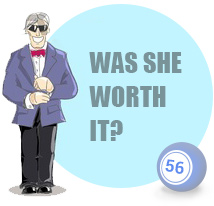 Going to more domestic matters, there seems to be an interesting controversy in the case of ‘Was she worth it?’. It is assigned as a name of ball 56, but also of ball 76. It is said that 5/6d was the pre-decimal price of marriage licence. Another variation of that price is 7/6d, so the same name goes for that number, too. Of course, it is quite easy to guess that the price in question was not uniform everywhere around the UK, or didn’t stay unchanged over an especially long period. Another theory is that marriage licence cost 7/6d, and 5/6d was the going price for a short time spent in a lady’s company during WWII.
What about religion? One would expect that to feature more, in fact. Maybe bingo goers were not very religious, or there may be another reason. In short, there is a single bingo ball referring to the Bible: 23 is called ‘God is my shepherd’, which is the opening line of Psalm 23. Apart from that we have ‘heaven’ mentioned in all numbers ending on 7, but that’s due to pure rhyme. So, there was not too much devotion among name authors, it seems.
The game itself is another point of reference for the fun calls: 45 is called ‘Halfway there’, 89 is ‘Nearly there’, and 90 is ‘Top of the shop’ denoting their respective location within the line of 90 numbers.
Resemblance and Rhymes
Certain numbers look like objects and that is where they got their fun names from. Ball No. 2 is easily recognised as ‘a little duck’, while 7 resembles ‘a little crutch’. That gave birth to weird combinations such as ‘a little duck with a crutch’ for 27, for example. When we think of number 8 looking like a robust woman, there is no surprise we can say ‘a fat lady with a crutch’ and mean number 87. Three takes the name of ‘flea’, possibly because it rhymes, too. It is also called ‘an ear’, or, in the case of 83, the association is somewhat graphic and crude, referring to a wisp of gas being let out of a bottom. We may not meet many spiritually-inspired calls, but we certainly do get some sassy names.
I have a favourite one and it got its fun name from two sources. I speak of ball 80, which is often called ‘Ghandi’s breakfast’. The number resembles a person sitting cross-legged in front of an empty plate, looked from above. Then, the number itself is called ‘Eight-Naught’, where 8 is pronounced as ‘ate’. Further on, we can think of Ghandi’s peace protest when he abstained from food, and there we have the whole picture. To me, this is one of the smartest fun bingo calls in the whole series.
As we have a nation of great poets, rhyming slang is bound to appear here, as well. You can check the boxes below.
-
- Rhyming slang
- Romantic: Ball 2 is ‘Me and you’.
- Association: 62 ‘To Waterloo’ – the train fare from Portsmouth to Waterloo station was 6/2d.
- Random: 3 ‘A cup of tea’, 8 ‘The garden gate’.
-
- Celebrities
- Ball 6 ‘Tom Mix’: a popular western film actor of the early 20th century.
- Danny LaRue who decorates ball 52 was a well-known drag performer.
We Live in Modern Times. Won’t They Change Those Stale Names?
I’d rather they won’t. Yet, we see new ones added, usually new celebrities. We can see JLo’s Bum is trying to make place for itself as the fun name of 71. We’ll see how that will fare. The new names don’t replace the old versions for now. Naturally, some calls are more popular than others depending on the bingo hall using them. In my opinion, we need to keep them as a nice reminder of what the game meant to the players in its heyday. True, land-based clubs tend to close down and more and more users go online, which renders the calls unnecessary. And yet, we can’t go on and cross the fun calls out yet, as the Internet has a way of giving new life to things.
Are you still at sixes and sevens regarding all these motley references and remarks? Then you will easily understand why ball 67 is sometimes called ‘the argumentative number’, no doubt.